
Of the four inscriptions that describe Moritasgus three identify him with Apollo. However the later discovery of a new statuette at Alesia led to Newell suggesting a more complex lineage including Serapis and Zeus.
In this post I try to unpick what is going on.
Contents
Moritasgus and Pluto or Serapis 7
Of the four inscriptions that describe Moritasgus three identify him with Apollo. However the later discovery of a new statuette at Alesia led to Newell suggesting a more complex lineage including Serapis and Zeus.
| 1 | 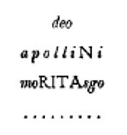 |
Discovered by Esperandieu in 1909 |
| 2 | 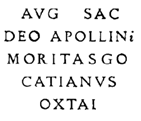 |
Discovered by Esperandieu in 1910 |
| 3 | 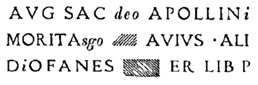 |
Discovered by Esperandieu in 1910 |
| 4 | 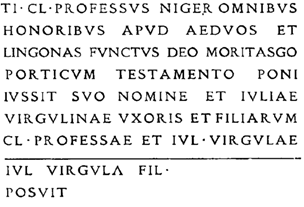 |
Now lost, but described by Esperandieu in his report on this 1910 dig. |
Moritasgus and Apollo
Emile Esperandieu discovered the temple of Moritasgus and holy springs at Alesia in 1910 and it was here that he discovered inscriptions #2 and #3. Not only do these directly refer to Apollo-Moritasgus, but their form also indicates the link:
#2 is inscribed on a stone representation of the human torso and #3 on a carving of a human leg. These donations to the god would have been supplicatory requests for the cure of ailments associated with these body parts.
Apollo is complex god, but one of his many aspects is that of a healer and this allows Esperandieu to state that:
Engraved, one on one thigh, the other below a trunk, the two inscriptions are from the sick who had come to ask the God for the restoration of their health. Thus, we learn, as said, that this god was called Moritasgus and that the Romans had identified him with Apollo
Moritasgus and the Doves
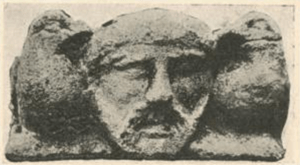
Among the many other findings from Alesia are several ‘dieu et colombes’ sculptures featuring a god with two doves whispering into his ears. These are not unusual within Gallo-Roman France, although the doves, as opposed to other birds, are more specific to the Cote d’Or region.
|
Figure 1: Dieu et colombes from Alesia |
Who does the statuary represent though? Four deities are known from the excavations around Alesia:
- Alisanus
- Ucuetis
- Bergusia
- Moritasgus
Nothing is known of the first and, in fact, the inscriptions do not come from Alesia but from the wider Cote d’Or region. Ucuetis and Bergusia are normally considered a matched god and goddess – eight representations of which have been discovered at Alesia, including the one shown below:
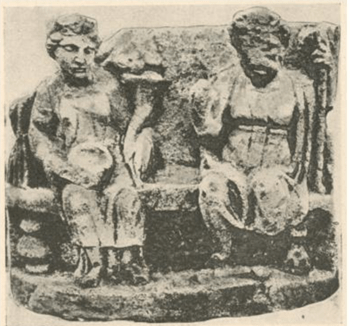
Figure 2: Ucuetis and Bergusia |
The only god left is Moritasgus and so this process of elimination suggests that he may be represented by the dieu aux colombes.
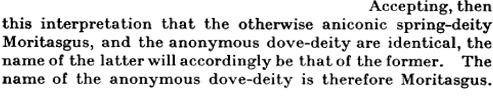
We can go further than this though and Newell (1939) posits that ‘a close and initimate relation subsists between doves and springs’. He does this with reference to classical mythology (the oracle at Dodona) and also to other Gallo-Roman sites with that link doves with Springs. He concludes that:
 |
A problem arises
The statue shown below, discovered in 1931, creates a conundrum though.
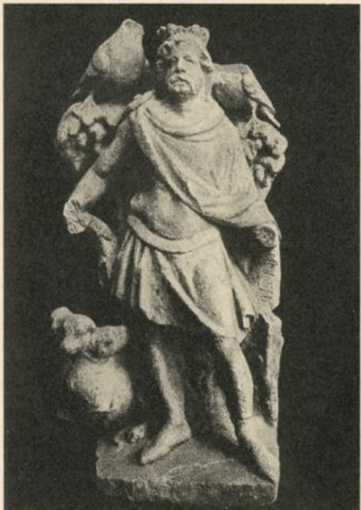
Figure 3: 1931 Statuette |
At first the two doves would indicate that we have another statue of Apollo-Moritasgus. Two immediate problems are that
- By the figure’s right foot is Cerberus, the three-headed guardian of the underworld.
- His head is surmounted with a ‘calathius, modius, or polos […] attributes be peculiar to the infernal powers’ (Newell, 1939)
This led Esperandieu to change his views and conclude that Apollo-Moritasgus was not the dove deity after all. Instead the deity would have to be either Alisanus or Ucuetis. His somewhat downhearted final word is that
…But there is no evidence that they had doves for attributes. It is therefore necessary to resign oneself to ignoring the Gallic name of the Alesian dove god until new discoveries will make it possible to name him (Comptes-rendus des séances de l année – Académie des inscriptions et belles-lettres, 1931)
Newell is less easily dissuaded, feeling that:
there is nothing inherently impossible in one deity (e.g. Moritasgus) of the vague and ill-defined Celtic pantheon being assimilated to more than one classical god
Newell now investigates two possible syncretises – between Moritasgus and Zeus and between Moritasgus and an Underworld God (either Pluto or Serapis).
The two underworld gods available are either Pluto or Serapis and Newell concludes that Serapis is the most likely.
Robert Parker in On Greek Religion (pg. 82) states that “The older literature is so full of claims that this or that god ‘has a chthonian aspect’ that one is left with few or any pure Olympians”
Moritasgus and Zeus
The Zeus linkage draws further on the Dodonian Zeus previously mentioned.
Dodona was an oracular site in Northwestern Greece, associated with Zeus from the earliest times – Ulysses consulted with Zeus there and Achilles prayed to him. The god dwelt in an oak tree that had a spring emerging from between its roots. His will revealed itself by the rustling of the branches and the murmuring of the water. Old women known as pigeons then carried out interpretation of the will.
There are striking parallels between this Dodonian Zeus and Moritasgus. Newell highlights four:
| Moritasgus | Zeus Ναϊος |
| Spring deity | Spring deity |
| Dove deity | Dove deity |
| Oak deity | Oak deity |
| Oracular (=chthonian) deity | Oracular (=chthonian) deity |
Dealing with these in order.
Spring Deity
At Alesia there is good evidence for this.
- Esperandieu’s “Note on the temple of the spring at Mount Auxois”
- The temple of Moritasgus as later described is in the form of a pool.
- It is also speculated the name Alesia may come from *alis, relating to springs. (From Wikipedia…)
It seems reasonable to conclude that Moritasgus is at least broadly connected with springs and water.
Dodonian refers to the oracle at Dodona, a temple dedicated to Zeus in North-western Greece. The Naos (Ναϊος) which is the same root as Naiads (Ναϊάδες) and so this Zeus can be Zeus of the Spring.
Dove Deity
If Moritasgus is indeed the figure shown in the statues such as Figure 1 then his linkage with doves is very clear.
The Dodonian priestesses were known as pigeons (or Doves – Peleiades) and had the role of interpreting the oracle.
Oak Deity
At this point Newell’s argument becomes rather more vague. Essentially:
- Moritasgus and the Dodonian Zeus clearly share dove and spring aspects. Zeus also has an oak aspect and we can infer that Moritasgus may as well.
- The doves in the statuette are resting on foliage, which may be oak leaves
In short:
Again, in our statuette, the sacred oak branches bearing the doves, remind us further that the dove-deity (Moritasgus) was, ipso facto, also a tree deity, who appears here as an oak spirit. (pg. 152)
Oracular Deity
The Dodonian Zeus was a famous oracle.
The evidence that Moritasgus was similarly oracular relies on the presence of the doves whispering in his ears and of of Cerberus sitting at his feet in the statuette. (Cerberus provides a link to the underworld that implies an oracular aspect.)
Overall, Newell concludes, Moritasgus is the main god of the area – the ‘local Jupiter’ as he puts it. However, the oracular nature of the site suggests that we cannot have straightforward ‘Olympian’ ruler, but must instead invoke a Chthonic counterpart.
Moritasgus and Pluto or Serapis
The Chthonic counterparts available for Moritasgus are either Pluto or Serapis Newell proposes a complex series of steps for associating Moritasgus with Serapis rather than Pluto.
- Dis Pater is the supreme deity of the Celts and their ultimate ancestor. [This view is no longer held – it comes from a quote by Caesar which is now taken as meaning that all the Celts felt they descended from a god who seemed to Caesar to like Dis Pater]
- Dis Pater is represented by a ‘Dieu au maillet’ (God with a hammer).
- Various sites link a ‘Dieu au maillet’ with a ‘dieu au oiseaux’. (And also to trees – “the bird-deity is, ipso facto, also a tree-spirit” pg. 149)
- So… God of birds is equivalent to Dis Pater
- Dis Pater, in turn, is related to the Graeco-Egyptian Serapis rather than the Graeco-Roman Pluto. This is because the Celts viewed the underworld as a place of light (like the Egyptians) and not as a place of darkness (like the Romans).
Summary
We can summarise the characteristics of Moritasgus as relating to healing, springs, doves, trees, and some link to the underworld. In addition we inscriptions linking him to Apollo.
These relationships are represented in the figure below.
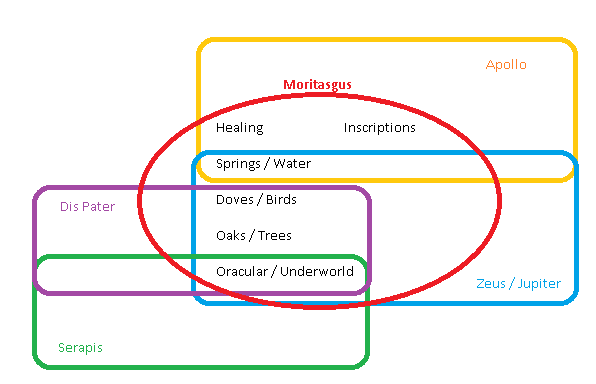
Moritasgus is a local Celtic deity, but becomes syncretised with various other divinities with whom he shares characteristics.
 Moritasgus