
The New Rulers: 240-350
240-300 was a time of crisis. Rome had to face war on every front. Even within the empire ‘local’ emperors ruled at times.
The aristocracy in heartlands ‘stuck to its ways and hoped for the best’, but the Roman Empire was saved by a ‘military revolution’. The army doubled in size, professional soldiers rose up through the ranks and the old aristocracy was excluded from military commands.
The new ‘aristocracy of service’ was meritocratic – the emperor Diocletian was the son of a freedman. They accepted Christianity. Clothing changed from togas to military uniforms.
But tradition still plays a part. ‘outside the bustling world of the court and the army the slow-moving traditionalist elements of the Roman world had survived’. The new upper classes make a self-conscious effort regain its roots and there is a flowering of craftsmanship and letter-writing. There is also a resurgence of scholars to service this new governing class.
It was a time of rapid change, but one that looked backwards to find meaning:
“It strained at […] producing men ‘raised by habitual discipline above the common mass of mankind’. Men sought, by studiously absorbing classical standards and literature and by modelling their behaviour on the ancient heroes a stability […] which they could no longer find in an unselfconscious participation in a traditional way of life. They were men who painfully aware that many of their roses were grafted onto a very primitive root stock.”
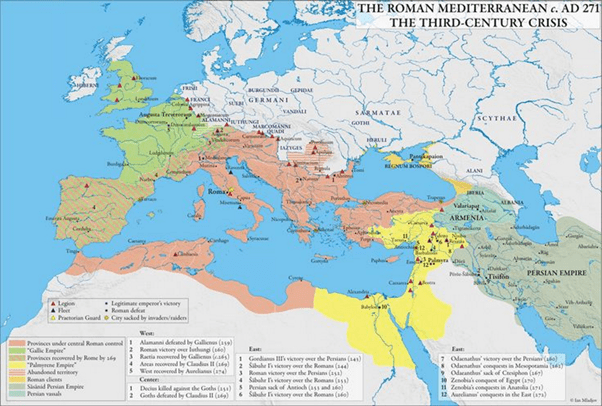
The central, pink section remains solid. But… The green north is ruled by ‘local’ emperor Postumus, the yellow east by his counterpart Zenobia. The Persian empire under the Sassanids is pushing up against the northeast. And the barbarian tribe names look threatening just beyond the borders. |
There has been a shaking of the ancient regime, and a release of talent and creativity as the nouveau riches create a new admixture of the old and the new.
 Moritasgus